[Quick Summary]
How do you fix short read lengths on a 3730 analyzer? If read lengths drop (e.g., from 1000 bp to 750 bp), it is likely a polymer issue. To resolve this, perform a 60 °C warm water wash and install a fresh bottle of polymer. If this does not restore data quality, you likely have a faulty polymer from a defective production lot. Order a different lot number immediately, perform a second wash, and install the new lot.
Reliable read lengths are the backbone of any sequencing workflow. When an instrument that usually delivers 1000 bp suddenly starts cutting off at 750 bp, the challenge is identifying exactly where the chemistry is breaking down. Before recalibrating your protocols or troubleshooting individual samples, it is worth checking for the tell-tale signs of a systemic reagent issue.
Identifying the Symptoms
When the issue is reagent-based, you will typically see a uniform decline in data quality that persists across every run. Look for these specific red flags in your recent data:
- Shrinking File Sizes: A noticeable ~10% drop in file size (e.g., seeing files decrease from a baseline of ~280 KB down to ~250 KB).
- Truncated Read Lengths: Data cutting off prematurely (e.g., losing the last 200–300 base pairs).
- Cross-Machine Failure: If multiple instruments begin failing within the same week, it strongly indicates a shared reagent lot issue.
The Diagnostic Key: Array Filling Time
To determine if the issue is mechanical or chemical, check your instrument’s Event Logs for the Array Filling Time.
In cases of polymer degradation, you may notice that fill times are only 15–20 seconds longer than your baseline service records. This specific, minor delay is a strong indicator that the hardware is functional, but the sequencing polymer is failing to provide the proper separation environment. This allows you to rule out a mechanical leak and focus on a reagent-based solution.
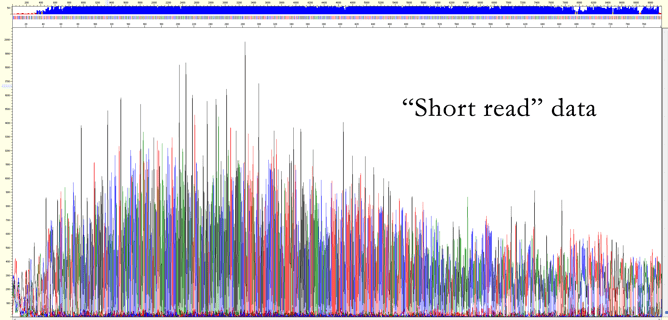
Chromatogram showing truncated data and a file size reduced to ~250 KB (a 10% reduction from the ~280 KB baseline) due to faulty polymer.
The 2-Phase Protocol to Restore Data Quality
Phase 1: Immediate System Reset
- Step 1: Warm Water Wash (60 °C)
Flush the fluid system using deionized water heated to 60 °C. This dissolves any polymer film or micro-clogs that have settled in the tubing. - Step 2: Install Fresh Polymer
Discard the current bottle and install a brand-new one. Even if it is from the same lot number, a fresh bottle rules out localized contamination. - Step 3: Order a New Lot Number
If Step 2 does not restore your read lengths, you likely have a faulty polymer from a defective production lot. Order a polymer bottle from a different production lot number immediately to minimize further downtime.
Phase 2: Escalation (New Lot Number)
Once your new lot number arrives:
- Step 1: Perform a Second 60 °C Warm Water Wash
Ensure the lines are completely clear of any previous chemistry. - Step 2: Install the New Lot Number
Load the fresh lot and verify the fix with a standard run.
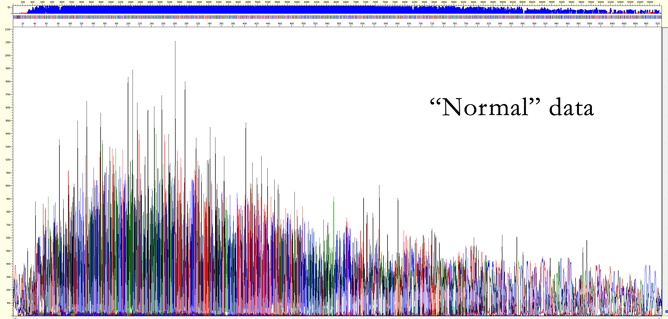
Successful 1000 bp+ recovery and restored file sizes (280–300 KB) following the Phase 2 protocol.
Why Does Sequencing Polymer Degrade?
When read lengths drop, the cause is almost always chemical rather than mechanical. Understanding these three triggers will help you prevent future downtime:
- Temperature Excursions: Polymer is highly sensitive to its environment. Moving a bottle frequently between the refrigerator and room temperature can cause premature chemical breakdown. To ensure stability, minimize the time the bottle spends out of cold storage.
- The "Topping Off" Trap: Never pour fresh polymer into an old bottle. Doing so "recycles" degraded chemicals into your new runs, leading to the exact "short data" issues described above.
- Manufacturing Defects: Occasionally, a specific production batch fails to meet the rigorous standards for capillary electrophoresis. If you have followed proper storage protocols and Phase 1 fails, the issue is likely a defective lot. Pivot to a new lot number immediately.
SeqGen specializes in the repair, maintenance, and refurbishment of essential laboratory instruments used in DNA sequencing and genetic research. Our expertise covers a wide range of equipment, including DNA sequencers like the ABI 3730/3730XL, 3500/3500XL, SCIEX LC/MS mass spectrometers such as the SCIEX 6500+, TECAN Freedom EVO liquid handlers, real-time PCR systems, thermal cyclers, and microplate readers. With experience in both current and legacy models, SeqGen provides cost-effective solutions at significantly lower prices than leading competitors.